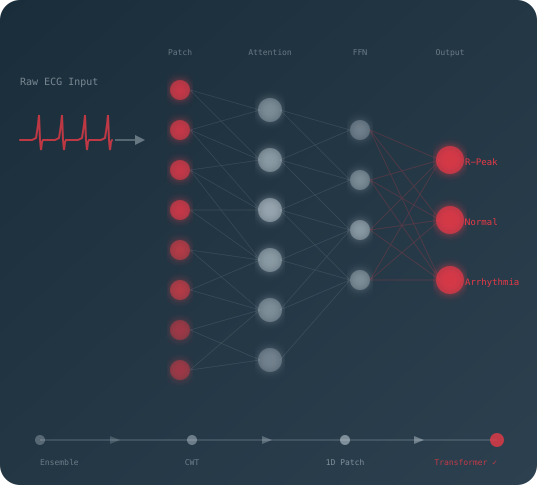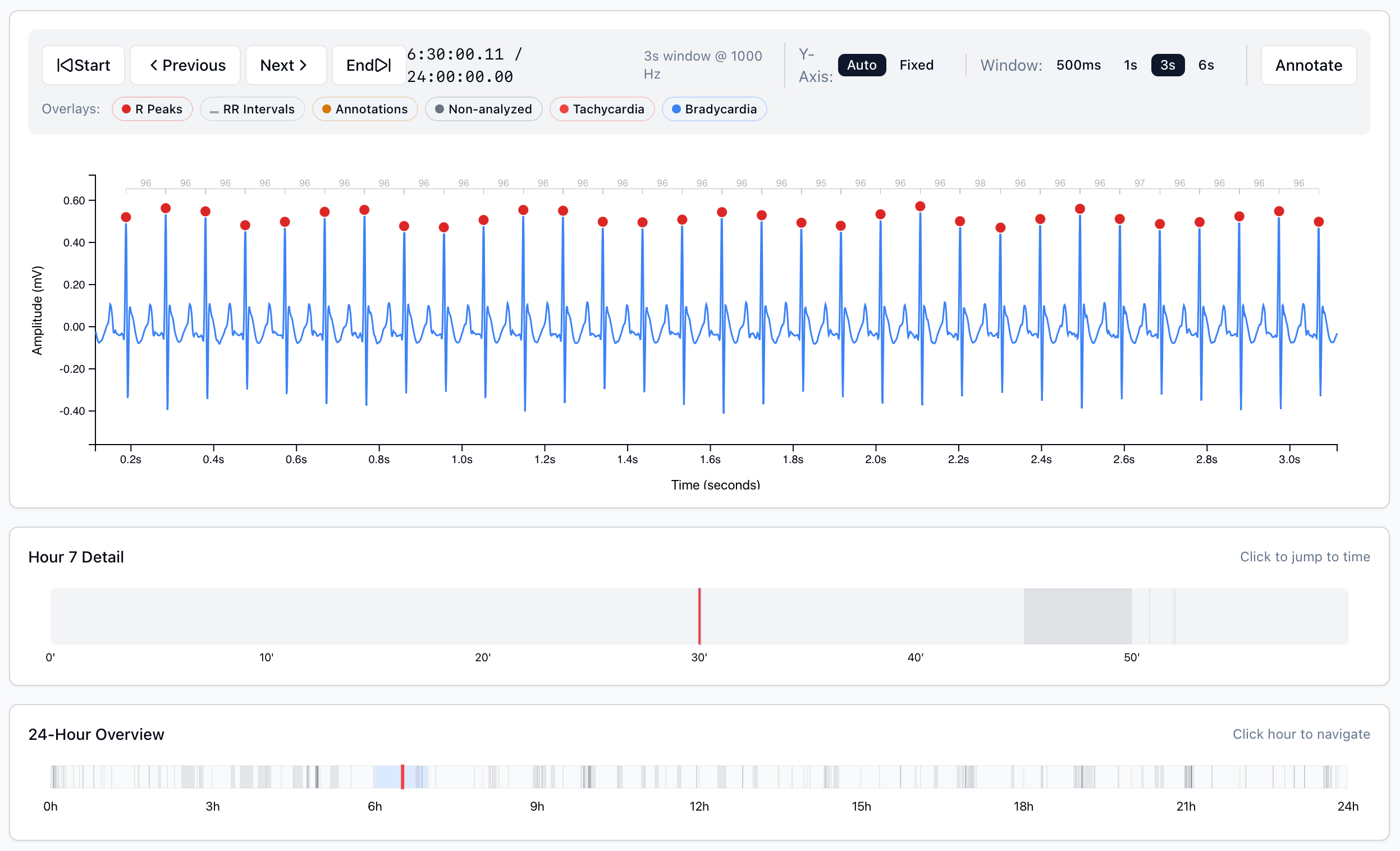
Automated R-peak detection
Identifies 600,000+ heartbeats in a single 24-hour recording with sub-millisecond precision, processing in approximately 90 seconds.
Mouse hearts beat 10× faster than human hearts, 450 to 750 BPM. The ECG signals are dense, fast, noisy. If our AI can master this, human ECG interpretation becomes a solved problem.
Mouse models are the gold standard in cardiac research, used globally to study disease mechanisms, drug responses, and genetic conditions before clinical trials. Building the AI here means it's already validated in the environment that matters most for upstream science.
Continuously updated, so your lab always has the latest detection capabilities. Used today, in production, by university researchers on real experimental data.
Identifies 600,000+ heartbeats in a single 24-hour recording with sub-millisecond precision, processing in approximately 90 seconds.
Detects bradycardia, tachycardia, atrial fibrillation, pauses, PVCs, ventricular tachycardia. New detection models in active development.
Full HRV, SDNN, RMSSD, pNN50, Poincaré plots. The metrics cardiac researchers need to publish.
Training and validating AI models on 24-hour mouse ECG recordings with expert cardiologist oversight.
Extending validated algorithms to human ECG data through clinical database integration.
Building physician review interfaces so expert corrections continuously improve the AI model.
Real-time AI cardiac diagnostics, starting with underserved rural facilities.
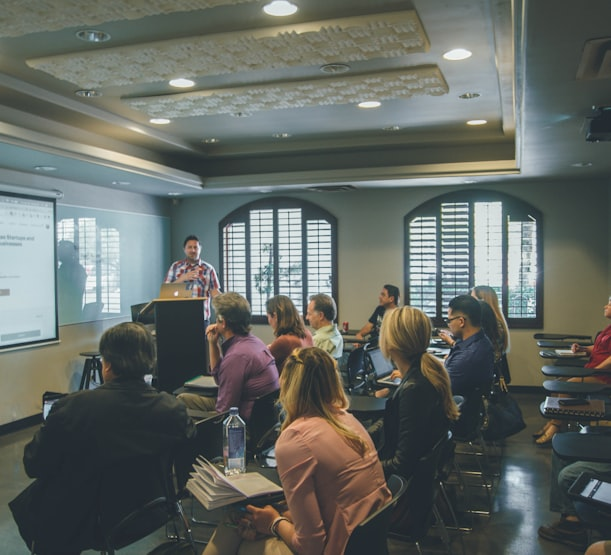
Our primary research collaboration is with the cardiac electrophysiology lab at a leading academic medical center. We process real experimental datasets, validate our algorithms against expert analysis, and iterate based on direct clinical feedback.
This partnership ensures our technology is shaped by the researchers who understand cardiac signals best.
AI model meeting or exceeding expert human analysis in R-peak detection validation.
24-hour recordings processed in ~90 seconds, enabling same-day research insights.
1D Patch Transformer trained on the most complex cardiac signals in electrophysiology.
Supporting real cardiac research at a leading university, today, in production.